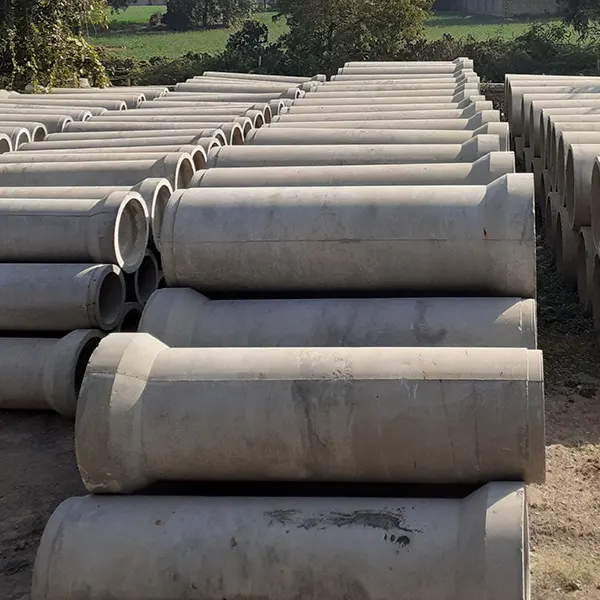
What is a drainage pipe? A drainage pipe is any pipe designed to carry water — rain runoff, sewage, or wastewater — away from a site, usually laid underground in a trench and connected in a network that runs by gravity to an outfall or treatment point.
The term covers more ground than most buyers realize. "Drainage pipe" can mean a small-diameter PVC line running off a roof, a corrugated HDPE line under a farm field, or a large-diameter reinforced concrete pipe carrying a municipal sewer trunk line under a main road. In Sonkatch, where drainage infrastructure spans everything from new residential colonies to the industrial belt along Ujjain Road, the material and size that's right for one project is often wrong for another — and picking based on price alone, without checking the load and flow it actually needs to handle, is the most common mistake buyers make.
For underground drainage carrying real load — road crossings, municipal sewer lines, industrial site drainage — reinforced cement concrete (RCC) pipe is generally the stronger choice over lighter plastic alternatives, because it's built to carry the external load of soil, traffic, and structures above it, not just resist internal water pressure. That's the material this page focuses on, though the guidance below applies to choosing any drainage pipe, regardless of what it's made of.
Whether you're a contractor bidding on a municipal drainage tender, a builder laying colony-level sewer lines, or a factory routing stormwater and effluent off an industrial plot in Sonkatch, the sections below walk through how to pick the right pipe — and where concrete drainage pipe fits versus the alternatives.
A drainage pipe buried under a road or a structure has to carry the weight of what's above it, not just move water through the bore — that's the actual engineering problem, and it's why load class matters more than diameter alone.
For high-load and long-service-life drainage — road crossings, municipal sewer trunk lines, industrial site drainage — RCC pipe is manufactured and reinforced specifically for the external load it will carry once buried.
Concrete drainage pipe is made to IS 458:2003, the governing Indian Standard covering dimensional tolerance and strength testing for concrete pipe — the specification most Madhya Pradesh municipal and PWD tenders call for by name.
Covers small residential drainage connections through large-diameter municipal sewer trunk lines, so one supplier can serve a project's full pipe schedule.
Joints are sealed with a rubber ring at the socket-and-spigot connection, keeping the line watertight without needing mortar pointing on every joint.
An external cement mortar coating protects the internal reinforcement from moisture, which is the actual mechanism behind long-term concrete pipe failure if left unprotected.
Local supply cuts transport distance and freight cost for projects across Sonkatch and the surrounding region — a real factor given how much a truckload of pipe weighs.
Buyers get help matching pipe material, diameter, and load class to the actual job — not just a size chart to pick a number off of.
| Parameter | Range / Detail |
|---|---|
| Material | Reinforced Cement Concrete (RCC) |
| Diameter | 80mm – 2000mm |
| Standard Length | 2m – 3m per pipe |
| Wall Thickness | 20mm – 200mm (varies by diameter and load class) |
| Load Class | NP2, NP3, NP4 (per IS 458:2003) |
| Joint Type | Socket and spigot, rubber ring sealed |
| Standard Compliance | IS 458:2003 |
| Coating | Cement mortar external coating |
| Material | Load Handling | Typical Use | Service Life |
|---|---|---|---|
| RCC / Concrete | High external load rating (NP2/NP3/NP4) | Municipal sewer lines, road crossings, industrial drainage, deep burial | 40-50+ years |
| PVC / uPVC | Lower external load rating | Residential SWR lines, low-load internal drainage | Moderate, material and installation dependent |
| HDPE / DWC Corrugated | Moderate, depends on wall construction | Field drainage, lighter-load underground lines | Moderate to long, installation dependent |
Every batch is checked against IS 458:2003 tolerances before dispatch — wall thickness, length, and joint fit are verified rather than assumed.Pipe that doesn't meet the dimensional or strength requirement for its ordered class is held back rather than shipped as a substitute.
Buying drainage pipe locally in Sonkatch cuts transport distance for a heavy product where freight adds up fast across a full tender quantity. Buyers also get load-class and material guidance from the people who actually manufacture the pipe, not a generic size chart from a reseller.