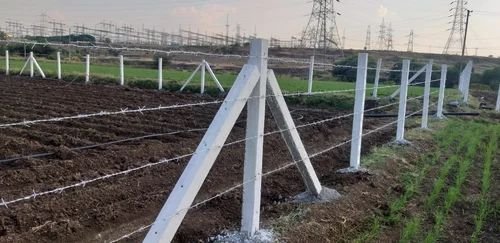
A fence is only as good as the posts holding it up, and that's where an RCC fencing pole earns its place over wood, angle iron, or plain cement alternatives. It's a precast reinforced concrete post — steel bars running through its core, cast in a rectangular or square section — built specifically to take the pull of stretched barbed wire or chain-link mesh without bending, rotting, or rusting through at ground level the way other materials eventually do.
Nagori Pipes manufactures RCC Fencing Poles in Dewas, casting them in the standard heights fencing contractors and landowners actually order — 5, 6, 7, and 10 feet being the most common — along with custom lengths for sites that don't fit the standard range. The poles are reinforced along their full length rather than only at stress points, which is what keeps a pole from snapping at the base when wire tension pulls sideways over years of use.
For anyone fencing farmland, an industrial plot, or a residential boundary in and around Dewas, sourcing poles locally solves a problem that doesn't show up until delivery day: RCC poles are heavy, and a truckload shipped in from outside the region adds real freight cost and real breakage risk before a single post goes in the ground. A Dewas-based manufacturer means shorter transit, fewer cracked poles on arrival, and a supplier who can turn around a repeat order fast when a fencing project runs longer than planned.
Some lower-cost poles concentrate steel only where the pole meets the ground, leaving the upper length more prone to cracking under wire tension. Nagori Pipes runs reinforcement bars the full length of each pole, so the section carrying the wire load is just as reinforced as the section set in the ground.
Poles are cast in 5, 6, 7, and 10-foot heights as standard stock, covering agricultural boundary fencing through to taller industrial and security fencing — with custom heights available for sites that fall outside that range.
Fencing a large plot or a farm boundary means ordering poles in the hundreds, not units. Production is set up to handle bulk quantities on a delivery schedule that matches a contractor's install timeline, rather than treating every order as a one-off.
Fencing poles fail most often from cracking, not from breaking outright — usually from thin concrete cover over the steel or a rushed cure. Poles are cast with adequate cover over the reinforcement and cured fully before dispatch, which is what actually prevents the hairline cracking that shows up within a season of installation on cheaper poles.
RCC poles chip and crack most often in transit, not in use. Producing them in Dewas for Dewas-area orders cuts the distance a heavy, brittle precast unit has to travel before it's even installed.
Poles can be cast with barbed-wire hooks pre-set at the spacing a project needs, avoiding on-site drilling or improvised wire-tying that weakens the installation over time.
| Parameter | Details |
|---|---|
| Material | Reinforced Cement Concrete (RCC) |
| Type | Precast |
| Standard Heights | 5 ft, 6 ft, 7 ft, 10 ft — custom lengths available |
| Shape | Rectangular / Square |
| Thickness | 2 to 4 inch (approx.), as per height and load |
| Concrete Grade | M25 / M30 (typical) |
| Finish | Smooth or polished |
| Color | Grey (natural) |
| Hooks | MS bar hooks for barbed wire fixing, spacing on request |
| Weight | Varies by height and thickness |
| Compliance | Manufactured with reference to IS 456:2000 for reinforced concrete |
Poles are cured fully before leaving the yard — a step that, when skipped under delivery pressure, is the most common reason a batch of fencing poles starts hairline-cracking within months of installation. Reinforcement runs the pole's full length rather than concentrating only at the base, and concrete cover over the steel is kept adequate to resist corrosion-driven cracking over the pole's service life.
| Factor | RCC Fencing Pole | Wood Post | Angle-Iron/GI Post |
|---|---|---|---|
| Rust/Rot Resistance | High — no rust, no rot | Rots over time, needs replacement | Rusts at ground contact over years |
| Maintenance | Minimal | Periodic treatment/replacement | Periodic anti-rust treatment |
| Upfront Cost | Moderate | Lower | Moderate to higher |
| Long-Term Cost | Lower (no replacement cycle) | Higher (recurring replacement) | Moderate (rust repair/replacement) |
| Wind/Wire-Tension Load | High, due to mass and reinforcement | Lower, especially once weathered | Moderate |
Nagori Pipes manufactures and supplies RCC Fencing Poles directly from Dewas, casting to standard heights or custom lengths depending on the fencing job, and handling both small residential orders and bulk quantities for agricultural, industrial, and tender projects. Poles are reinforced along their full length and cured fully before dispatch, rather than rushed out to meet a delivery date at the cost of durability.