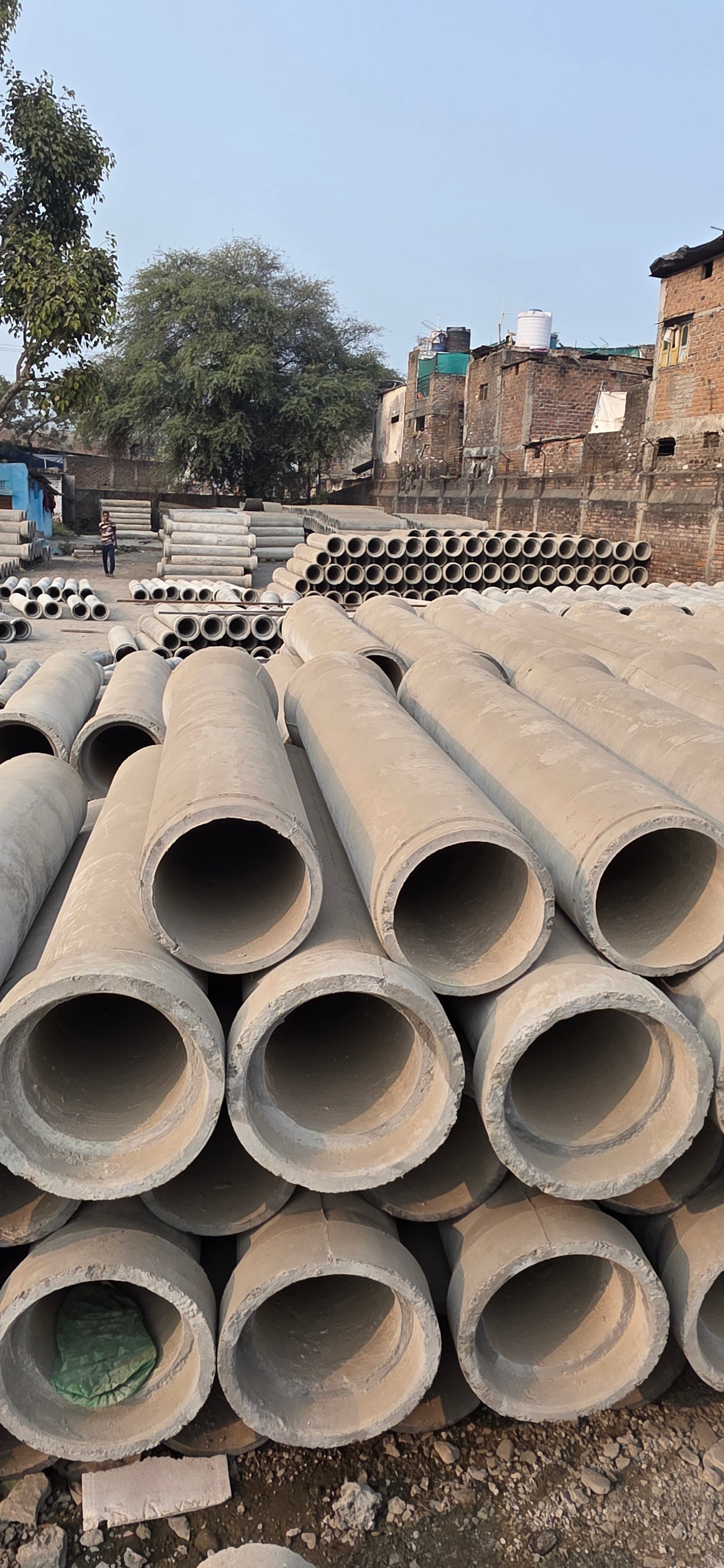
What is an RCC Hume pipe? An RCC Hume pipe is a reinforced cement concrete pipe manufactured by the centrifugal spinning process, used mainly for non-pressure applications like drainage, sewerage, and culverts. The reinforcement inside the concrete wall is what lets it carry external load from soil, traffic, and construction above it without cracking.
Indore Kanadiya sits at the center of a fast-growing industrial and municipal construction corridor in Madhya Pradesh — new residential colonies, road-widening projects, and industrial area drainage all need pipe that's rated for the load it will actually carry, not just "concrete pipe" bought on price alone. That's the gap a lot of buyers fall into: they compare two quotes with the same diameter and pick the cheaper one, without checking whether it's NP2 or NP3 class, and end up with a pipe that cracks under a road crossing it wasn't built for.
RCC Hume pipes are built the way they are — centrifugally spun, reinforced with steel cages sized to the load class, cured under controlled conditions — because that process is what gives the pipe its strength-to-weight ratio and its long service life underground. A pipe manufactured this way typically outlasts alternatives like plain cement pipe or PVC in heavy-load underground applications, which is why government tenders and municipal specifications in Madhya Pradesh still call for IS 458 compliant RCC pipe by name.
For buyers in Indore Kanadiya — whether you're a contractor bidding on a drainage tender, a builder laying society-level sewer lines, or a factory owner routing stormwater off an industrial plot — the pipe you choose has to match both the diameter of the flow and the load class of what's sitting on top of it. The sections below walk through both.
Centrifugal Spinning for Denser Concrete—The pipe is cast using the centrifugal (spun) process rather than static casting, which packs the concrete tighter against the mould wall under rotational force. Denser concrete means fewer voids for water to seep through over time, and a smoother bore that resists silt buildup.
Reinforcement Cage Matched to Load Class—Steel reinforcement is sized and placed according to the NP class ordered — NP2, NP3, or NP4 — not a single generic cage used across every order. This is the actual mechanism behind load rating; it's not a marketing label.
IS 458 Compliant Manufacturing—Pipes are made to IS 458:2003 specifications, the governing Indian Standard for concrete pipes, covering everything from wall thickness tolerances to crushing-strength test requirements. [Confirm: any additional lab test certificates available]
Socket-and-Spigot Jointing with Rubber Ring Seal—Joints use a socket-and-spigot design sealed with a rubber ring, which keeps the line watertight at the joint without needing mortar pointing on every section — faster to lay, and less likely to leak at the joint over time.
Size Range from 80mm to 2000mm—Covers everything from small residential drainage connections up to large-diameter municipal sewer trunk lines, so a single supplier can serve both ends of a project's pipe schedule.
Cement Mortar Coating for Corrosion Resistance—An external cement mortar coating protects the reinforcement from moisture ingress, which is the actual failure mode that causes reinforced concrete pipe to deteriorate early — corrosion of the steel inside, not the concrete itself.
Curing Under Controlled Conditions—Pipes are cured for the time and conditions the mix design calls for before dispatch, rather than rushed out early — this is what lets the concrete reach its rated crushing strength before it's ever loaded on-site.
| Parameter | Range / Detail |
|---|---|
| Diameter | 80mm – 2000mm |
| Standard Length | 2m – 3m per pipe |
| Wall Thickness | 20mm – 200mm (varies by diameter and NP class) |
| Load Class | NP2, NP3, NP4 (per IS 458:2003) |
| Joint Type | Socket and spigot, rubber ring sealed |
| Class | Typical Use | Load Handling | Best For |
|---|---|---|---|
| NP2 | Light-duty drainage | Lower external load rating | Field drains, light-cover areas with no vehicle traffic |
| NP3 | General drainage & sewerage | Moderate external load rating | Most municipal sewer lines, moderate-traffic road crossings |
| NP4 | Heavy-duty drainage | Highest external load rating | Deep burial, heavy vehicle traffic, industrial areas |
Buying RCC Hume pipe locally in Indore Kanadiya means shorter transport distance for a heavy, bulky product — freight cost on pipe adds up fast over a full tender quantity.Working directly with the manufacturer also means load-class and dimension questions get answered by someone who actually made the pipe, not a reseller repeating a spec sheet.