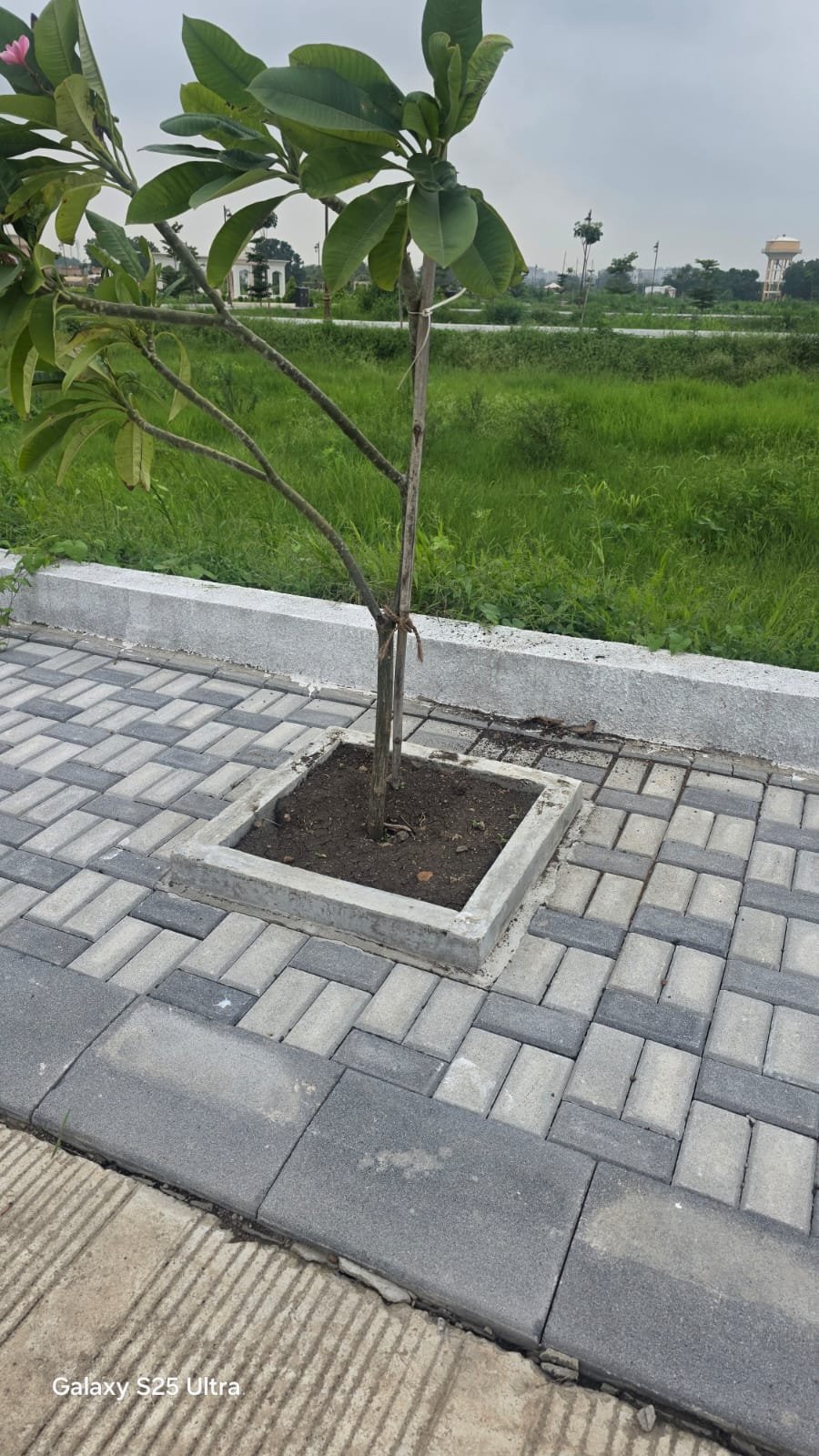
Walk any avenue plantation drive, municipal park, or newly developed colony and the pattern repeats: rows of young saplings planted with good intentions, and no protection around half of them within a year. A tree guard is the difference — a barrier around the base sturdy enough to survive vehicle brush-past, cattle, and the general wear of a public space until the tree's trunk is thick enough to no longer need it.
Square Concrete Tree Guards do this job in precast reinforced concrete, cast as interlocking square segments that assemble around the sapling without needing to be built in place. Nagori Pipes manufactures them in Sonkatch to standard heights suited to typical park and roadside plantation, with custom sizing available where a wider trunk or a taller guard is specified.
The reason a local Sonkatch source matters here is mostly logistical, and it shows up fastest on large orders. Municipal plantation drives and institutional greening projects order tree guards by the dozen or the hundred, on a schedule tied to a monsoon planting window — and a precast concrete product shipped in from outside the region adds both transit time and breakage risk right when a project can least afford either. A manufacturer based in Sonkatch cuts both.
Segments are cast to interlock around the sapling without needing on-site welding, bolting, or curing — a planting crew can assemble a guard directly at the site in minutes, which matters on large plantation drives running against a monsoon window.
Steel reinforcement runs through each segment to resist cracking on impact — from a grazing animal, a passing vehicle's mirror, or a cart wheel brushing past — rather than relying on concrete mass alone.
Standard sizes suit typical sapling plantings, with custom dimensions available for wider trunks or projects that specify a particular guard height and width.
Municipal and institutional plantation programs often need tree guards in large quantities on a fixed schedule — production is set up to deliver bulk orders in batches that match a planting timeline rather than treating each order individually.
Precast concrete segments chip and crack most often in transit over long distances. Manufacturing locally in Sonkatch keeps that risk down for regional orders, which matters more on a bulk order than a single unit.
Unlike wooden guards that rot or metal mesh that rusts and bends, precast concrete segments hold their shape through repeated monsoon exposure and years of outdoor use without structural degradation.
| Factor | Square Concrete Tree Guard | Metal Mesh Guard | Plastic Tree Guard |
|---|---|---|---|
| Rust/Corrosion | None | Rusts over time | None, but degrades under UV |
| Theft/Scrap Risk | None | Higher (scrap value) | Low |
| Impact Resistance | High — holds shape | Moderate — can bend inward | Lower — can crack or deform |
| Maintenance | Minimal | Periodic anti-rust treatment | Periodic replacement |
| Typical Use | Roadside, park, bulk institutional plantation | Garden, low-risk areas | Nursery, temporary plantation |
Segments are cured fully before dispatch, which is the main factor determining whether a guard survives its first year of field impact without cracking. Reinforcement is placed to resist the kind of impact tree guards actually face — vehicle contact, animal pressure, casual knocks — rather than sized only for static load. Dimensional consistency is checked across a batch so bulk orders assemble cleanly on-site without mismatched segments.
Nagori Pipes manufactures and supplies Square Concrete Tree Guards directly from Sonkatch, casting interlocking segments to standard or custom sizing for single plantings and bulk plantation drives alike. Segments are reinforced to resist the actual impact tree guards face in the field and cured fully before dispatch, rather than rushed to meet a delivery date.